In I think the penultimate chapter of Mark Cousins' otherwise
excellent thirteen part documentary 'The Story of Film: An Odyssey', the author became enamoured with the word 'digital' and started liberally applying it pretty much everywhere. And I became really, really confused (surely the opposite of the intended result?). CG effects have really taken off in the last 30 years, but computers themselves have been used in/ for effects for even longer than that.
Shooting digitally has only become commonplace in the last five years
or so. Laserdiscs and DVDs both date from the 90s. And digital
projection has only really been around for the last decade. Unless I'm
missing something, the links between many of those actual, individual technologies
is tenuous at best - the only common thing I can think of is, um,
movies.
Although different aspects of this (as a whole) technological
revolution are of course other blog posts, this one - almost, but not quite contradicting what I wrote above - is about a weird
result from the confluence between home video and digital projection and
that would be blu-ray. A little like the way longstanding TV sets like 'Eastenders' (as opposed to longstanding TV sets such as the one probably in your living room) had to be spruced up for HD owing to the broadcast quality showing up previously undetectable flaws, blu-ray releases have necessitated a lot of film restoration. One of the best examples of this is the canon of 22 Bond movies (yes I know that the producers have obtained the rights to 'Never Say Never Again' and the first film adaptation of 'Casino Royale', but let's be honest: they're always going to be treated like unwanted stepchildren and no, I wasn't looking for an excuse to mention Bond films). Home video sets of the series through the years have sold truckloads in those we-didn't-know-what-to-get-you-for-Christmas-but-you-love-Bond-movies-right?/ another-version?-I-have-to-have-it! kinds of way and the producers and studio make quite a lot from the back catalogue every year as a result. As a result, the advent of blu-ray led to the producers getting the back catalogue restored in very, very high-def (8k for technical geeks) by the outfit formerly known as Lowry Digital. This would ensure not only pristine blu-ray releases, but also awesome, whatever-comes-next releases too, whether that be another disc format, HD home streaming or even-more-'H'D home streaming. I'm leaving the subject of blu-ray transfers for another post, but - awesome side effect alert! - the producers actually ended up with digital prints that weren't just good enough for cinema release, but which probably look a whole lot better than any original release. As a result of this, the producers were able to do a limited series of cinema re-releases for some of the most popular Bond movies.
The Bond folks weren't the only ones who cottoned on to this of course and all kinds of movies are now getting short cinema re-releases. I'm saving the subject of 3D re-releasing for another post, but regular 2D re-releases include 'Jurassic Park', 'John Carpenter's The Thing', 'Ghostbusters', 'Back To The Future' (which was strangely UK-only) & 'Scarface'. I came thisclose to leaving 'Blade Runner' off the list, since it was the newly minted Ultimate Edition rather than the original theatrical cut, but since Ridley Scott was merely finishing it off rather than fundamentally changing it, it would be wrong to omit it.
So what did I learn apart from reiterating that the experience of watching in a film in a movie theatre (annoying patrons aside) really is nothing like watching it at home, no matter how good your home cinema set-up is? 'Scarface' is not actually a brilliant movie, but is still rollicking good entertainment. 'The Thing' is ruddy terrifying; you'd think a large screen and cleaned up picture might expose weaknesses in Rob Bottin's creature designs, but this didn't turn out to be the case at all. 'Blade Runner' is even more immersing than watching it at home; if you're lucky enough to have a well-designed auditorium, the opening sequence makes you feel like you're actually floating and you really get how cleverly the physical effects on the cityscape were designed to sell you that illusion and this film doesn't let up at all - it's just sheer genius throughout. 'Jurassic Park' hasn't aged well at all; while I loved the film on its original release and watched the video over and over again, seeing at the cinema with the benefit of age (but maybe not so much wisdom) made it feel like a series of not-that-well-strung-together set pieces and ultimately rather hollow.
'Back To The Future' and 'The Lion King' however - which we chose to watch in 2D - were particularly poignant. I was distracted by a slight, continuous noise during the wildebeest stampede in the latter, which of course ends up Simba's realisation that Mufasa has died; I'd figured that maybe one of the speakers was distorting from all the bass. Just as he crawls under his dad's paw, in absolute silence, the noise suddenly amplified into a now clearly identifiable child's wailing, who then screamed "Mummy! Make it stop!". It was simultaneously funny and incredibly moving, as I realised that in twenty or thirty years time that child would talk about this as a seminal moment, the same way people of my generation talk about feeling devastated when Bambi's mum got shot and that I'd been there to witness it; a seventeen year old movie reducing a new generation to tears. Although I cried plenty of times myself, but don't tell anyone.
'Back To The Future' was just as fun, albeit a slightly different experience. The movie itself hasn't dated a jot. It's just as endlessly quotable as ever. The actors all just get it and do their utmost to invest everything in their characters, all of whom are perfectly realised. The direction never flags, the script is just a sheer joy. The score felt vibrant and the whole film just came alive. The cinema was also full of families, which is something I usually dread thanks to parents who often don't give a monkey's what their kids are doing or what disruption they're wreaking on anyone else. And they were all absolutely silent. Not a peep. And I realised that when the movie really is that good - admittedly a rarity - that audiences will of course behave themselves. Two things occurred to me: the first was how cool it had been to watch the movie with other people who'd grown up with it and who were now presumably recreating that experience with their own children. The second was about the movie itself. 'Back To The Future' was of course made for family audiences, but it has charm, characters and edge. Would anyone make a movie with the line "Great Scott! The Libyans!" now? I don't think so. Would anyone make a film now where the (er) teenage hero's best friend is the crazy, old, single guy who lives as a recluse on the other side of town? That would be 'no'. Is anyone going to talk with reverence and love for any of the Transformers movies in quarter of a century's time the way that people like me can talk about 'Back To The Future' now (yes, it'll be twenty-seven this year). That would also be 'no'. I shouldn't pick on Transformers movies (the problem is that it's just too much fun) and I actually don't have to: there's plenty of vacuous, utterly disposable entertainment out there. Pick a big, recent popcorn movie or series (e.g. Pirates of the Caribbean) and ask yourselves if anyone's going to love them in twenty-five years. Is anyone actually going to remember them in twenty-five years? Just because something's made for a mainstream audience or a family audience doesn't mean that it can skimp on fun, exuberance, entertainment value, great characterisation or any of the other hallmarks of great movies. The second thing I learnt from seeing 'Back To The Future' at the cinema was that the greatest gift of digital cinema re-releases is that we can find those qualities in mainstream films at the cinema again, albeit in movies that we already know and love.
Showing posts with label Cinemas. Show all posts
Showing posts with label Cinemas. Show all posts
Tuesday, January 31, 2012

Wednesday, December 28, 2011
A Tale of Two Cinemas or The Fine Art of Cinema Programming
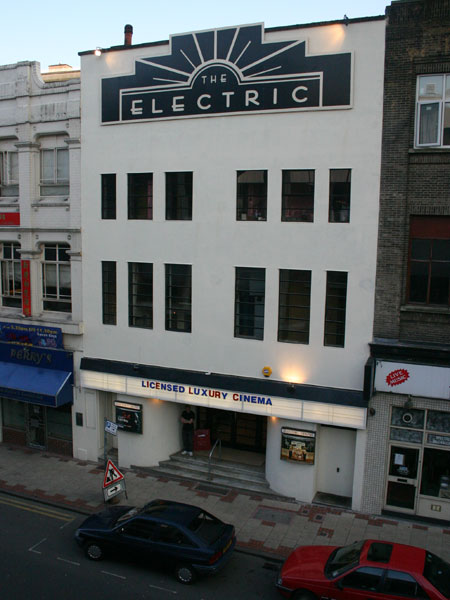
When I first moved to the West Midlands in 1998, I discovered Birmingham's most famous repertory cinema - The Electric in the heart of Birmingham. Tickets were cheap, especially for double-bills and particularly for the large category of concessions, of which I wasn't one. The seats were slashed, both auditoriums smelt of wee (there were occasional tramps in for the afternoon double-bills, presumably for the warmth), the raking on the ground floor left quite a lot to be desired (leading to largish audiences - of which there were admittedly few - sitting in that weird chequerboard pattern that seems to form quite naturally) and the toilets were pretty horrid. I didn't care a jot of course. I watched all but two of Pedro Almodovar's movies in a huge celebration leading up to the release of his new movie, 'All About My Mother' (still one of my favourites of his). I watched 'Once Upon a Time in The West' on the big screen (and on film at that), an experience that no home viewing experience can ever quite replicate. I saw Marx Brothers movies ('A Night at The Opera' and 'Duck Soup') that I couldn't remember seeing before, although I probably had when I was too young to either remember or appreciate them. The same guy used to sell me my ticket, take a pittance for a fantastically stodgy slice of cake and then tear my ticket. And probably ran upstairs to turn the projector on. For a cinephile, the place was as close to heaven as it got. I loved it.
The then-Virgin chain opened a cinema that was less than ten minutes walk from my flat: twelve screens with perfect air conditioning, THX-certified sound, perfect raking & legroom. The programming included both blockbusters and indie movies from all over the world (Almodovar's newer releases, Susanne Bier, Lars von Trier, Studio Ghibli, you name it). A (then available) four-weekly or eight-weekly pass cost next to nothing. My monthly cinema bill went down from £100-£150 to less than a tenth of that. My visits to the Electric dropped to zero.

A few years later, The Electric closed and the building was left derelict. I felt a slight pang of remorse on my way to air-conditioned luxury and a perfect view as I knew that it was people like me who were responsible, but how could The Electric compete with great facilities and note-perfect programming? Sure, I had to go out and moan occasionally about an out-of-focus picture, missing sound or noisy patrons as opposed to The Electric's silence and rock-solid projection, but this was a small price to pay; a very small price (see above: less than a tenth).
My Cineworld went all digital; the first conversions were pretty obviously funded by European grant money, judging from the first movies shown on those two screens (10 & 12 for detail obsessives). But once whatever contractually-obligated minimum period had expired and as it started to make commercial sense to convert all the other screens, the cinema discovered the commercial benefits of Bollywood movies, a category I have absolutely no interest in. All of a sudden the cinema effectively lost two or three screens to me and the indie movies I loved were nowhere to be found.
The Electric meanwhile reopened as some kind of luxury cinema with leather sofas, stuffed olives and various flavours of gin. Both screens are now digital and look pretty good (the digital vs. film is a topic for another time). But I noticed that one week in 2009, one screen was playing the new 'Star Trek' movie while the other was playing 'Angels & Demons', both of which I'd assumed might be generally pretty accessible elsewhere. On one particularly memorable occasion, I went to see a one-off screening of 'The Spy Who Loved Me' (the first movie I can remember seeing at the cinema) with Richard Kiel who plays Jaws in attendance. My boyfriend was pretty ill and I was fairly drunk, but the main reason I walked out was because after presumably failing to get hold of a print, the cinema was projecting the DVD. The DVD. Not a blu-ray. The DVD. No-one else with their olives, their gin or their sofas seemed to mind. Needless to say I've never been back. And I'm never going to go back. I can't really think of a reason to pay to watch a movie on someone else's home cinema set-up when I have a perfectly good one at, well, home.
Do I blame myself for the fact that a lot of my movie-watching nevertheless now has to be done at home, courtesy of LoveFilm? Of course I do; I'm not an idiot. There are many lessons to be learned from this story, lessons about the power of monopoly, the true price of short-term financial gain, that it's better to have loved and lost than never to have loved at all, that you get what you pay for. But the main lesson? Never just walk out of a movie and run outside to get a cab, always stop and moan at the staff for projecting a ruddy DVD first; you'll never want to speak to them again after you've left.
Subscribe to:
Posts (Atom)