In I think the penultimate chapter of Mark Cousins' otherwise
excellent thirteen part documentary 'The Story of Film: An Odyssey', the author became enamoured with the word 'digital' and started liberally applying it pretty much everywhere. And I became really, really confused (surely the opposite of the intended result?). CG effects have really taken off in the last 30 years, but computers themselves have been used in/ for effects for even longer than that.
Shooting digitally has only become commonplace in the last five years
or so. Laserdiscs and DVDs both date from the 90s. And digital
projection has only really been around for the last decade. Unless I'm
missing something, the links between many of those actual, individual technologies
is tenuous at best - the only common thing I can think of is, um,
movies.
Although different aspects of this (as a whole) technological
revolution are of course other blog posts, this one - almost, but not quite contradicting what I wrote above - is about a weird
result from the confluence between home video and digital projection and
that would be blu-ray. A little like the way longstanding TV sets like 'Eastenders' (as opposed to longstanding TV sets such as the one probably in your living room) had to be spruced up for HD owing to the broadcast quality showing up previously undetectable flaws, blu-ray releases have necessitated a lot of film restoration. One of the best examples of this is the canon of 22 Bond movies (yes I know that the producers have obtained the rights to 'Never Say Never Again' and the first film adaptation of 'Casino Royale', but let's be honest: they're always going to be treated like unwanted stepchildren and no, I wasn't looking for an excuse to mention Bond films). Home video sets of the series through the years have sold truckloads in those we-didn't-know-what-to-get-you-for-Christmas-but-you-love-Bond-movies-right?/ another-version?-I-have-to-have-it! kinds of way and the producers and studio make quite a lot from the back catalogue every year as a result. As a result, the advent of blu-ray led to the producers getting the back catalogue restored in very, very high-def (8k for technical geeks) by the outfit formerly known as Lowry Digital. This would ensure not only pristine blu-ray releases, but also awesome, whatever-comes-next releases too, whether that be another disc format, HD home streaming or even-more-'H'D home streaming. I'm leaving the subject of blu-ray transfers for another post, but - awesome side effect alert! - the producers actually ended up with digital prints that weren't just good enough for cinema release, but which probably look a whole lot better than any original release. As a result of this, the producers were able to do a limited series of cinema re-releases for some of the most popular Bond movies.
The Bond folks weren't the only ones who cottoned on to this of course and all kinds of movies are now getting short cinema re-releases. I'm saving the subject of 3D re-releasing for another post, but regular 2D re-releases include 'Jurassic Park', 'John Carpenter's The Thing', 'Ghostbusters', 'Back To The Future' (which was strangely UK-only) & 'Scarface'. I came thisclose to leaving 'Blade Runner' off the list, since it was the newly minted Ultimate Edition rather than the original theatrical cut, but since Ridley Scott was merely finishing it off rather than fundamentally changing it, it would be wrong to omit it.
So what did I learn apart from reiterating that the experience of watching in a film in a movie theatre (annoying patrons aside) really is nothing like watching it at home, no matter how good your home cinema set-up is? 'Scarface' is not actually a brilliant movie, but is still rollicking good entertainment. 'The Thing' is ruddy terrifying; you'd think a large screen and cleaned up picture might expose weaknesses in Rob Bottin's creature designs, but this didn't turn out to be the case at all. 'Blade Runner' is even more immersing than watching it at home; if you're lucky enough to have a well-designed auditorium, the opening sequence makes you feel like you're actually floating and you really get how cleverly the physical effects on the cityscape were designed to sell you that illusion and this film doesn't let up at all - it's just sheer genius throughout. 'Jurassic Park' hasn't aged well at all; while I loved the film on its original release and watched the video over and over again, seeing at the cinema with the benefit of age (but maybe not so much wisdom) made it feel like a series of not-that-well-strung-together set pieces and ultimately rather hollow.
'Back To The Future' and 'The Lion King' however - which we chose to watch in 2D - were particularly poignant. I was distracted by a slight, continuous noise during the wildebeest stampede in the latter, which of course ends up Simba's realisation that Mufasa has died; I'd figured that maybe one of the speakers was distorting from all the bass. Just as he crawls under his dad's paw, in absolute silence, the noise suddenly amplified into a now clearly identifiable child's wailing, who then screamed "Mummy! Make it stop!". It was simultaneously funny and incredibly moving, as I realised that in twenty or thirty years time that child would talk about this as a seminal moment, the same way people of my generation talk about feeling devastated when Bambi's mum got shot and that I'd been there to witness it; a seventeen year old movie reducing a new generation to tears. Although I cried plenty of times myself, but don't tell anyone.
'Back To The Future' was just as fun, albeit a slightly different experience. The movie itself hasn't dated a jot. It's just as endlessly quotable as ever. The actors all just get it and do their utmost to invest everything in their characters, all of whom are perfectly realised. The direction never flags, the script is just a sheer joy. The score felt vibrant and the whole film just came alive. The cinema was also full of families, which is something I usually dread thanks to parents who often don't give a monkey's what their kids are doing or what disruption they're wreaking on anyone else. And they were all absolutely silent. Not a peep. And I realised that when the movie really is that good - admittedly a rarity - that audiences will of course behave themselves. Two things occurred to me: the first was how cool it had been to watch the movie with other people who'd grown up with it and who were now presumably recreating that experience with their own children. The second was about the movie itself. 'Back To The Future' was of course made for family audiences, but it has charm, characters and edge. Would anyone make a movie with the line "Great Scott! The Libyans!" now? I don't think so. Would anyone make a film now where the (er) teenage hero's best friend is the crazy, old, single guy who lives as a recluse on the other side of town? That would be 'no'. Is anyone going to talk with reverence and love for any of the Transformers movies in quarter of a century's time the way that people like me can talk about 'Back To The Future' now (yes, it'll be twenty-seven this year). That would also be 'no'. I shouldn't pick on Transformers movies (the problem is that it's just too much fun) and I actually don't have to: there's plenty of vacuous, utterly disposable entertainment out there. Pick a big, recent popcorn movie or series (e.g. Pirates of the Caribbean) and ask yourselves if anyone's going to love them in twenty-five years. Is anyone actually going to remember them in twenty-five years? Just because something's made for a mainstream audience or a family audience doesn't mean that it can skimp on fun, exuberance, entertainment value, great characterisation or any of the other hallmarks of great movies. The second thing I learnt from seeing 'Back To The Future' at the cinema was that the greatest gift of digital cinema re-releases is that we can find those qualities in mainstream films at the cinema again, albeit in movies that we already know and love.
Tuesday, January 31, 2012

Saturday, January 14, 2012
Directors' Late Periods
Many creative people often follow artistic trajectories similar to three-act/ narrative arc structures so fondly promoted in scriptwriting seminars & (after being dumbed down) prevalent in stereotypical, mainstream Hollywood movies. So it is that many directors nearer the end of their film making lives than their start are often portrayed as being in a creative decline. The careers of three of the great so-called movie brats of the 70s provide interesting & contrasting examples of what later artistic endeavours can look like.
Steven Spielberg is widely revered as a film making genius, one of the few directors alive or dead whose name is known by pretty much all cinema-going audiences. His grip on the popular imagination with movies such as 'Jaws', 'Close Encounters of The Third Kind', 'E.T.', 'Jurassic Park' and the Indiana Jones movies - which between them pretty much defined the blockbuster era - is extraordinary. He has his critics of course, people who accuse him of being overly-sentimental or pandering to cheap populism, criticisms that I personally think have some basis in truth but perhaps ignore the greater marvel of being able to spin a fairytale like 'E.T.' and have as many people emotionally engage with it as they do. He's also long evinced a desire to be taken seriously, starting with 'The Color Purple' (sic) and leading to awards recognition for 'Schindler's List', a film that I think is certainly extraordinary in parts but which is ruined by the, um, overly-sentimental ending. In the first half of the last decade, Spielberg experimented with darker material than previously, leading to the posthumous Kubrick "collaboration" 'A.I.' (one of my favourites) and 'Munich' (a gripping meditation on morality, violence and retribution that's still my favourite Spielberg movie). Since then however he's made a fourth Indiana Jones (which felt like a joyless, almost unwatchable, cheap retread of the iconic original trilogy) and 'The Adventures of Tintin', which is entertaining, forgettable and which owes much of its worth to, well, Indiana Jones. Yesterday, while watching 'War Horse', I found myself looking at my watch every thirty seconds or so in the first quarter of an hour. The first three quarters of an hour - until the first sequence in WW1 - felt interminable and I sat wondering about leaving and maybe coming home and reading the paper. The sequences in the war itself were superb (shades of 'Saving Private Ryan' here) but the interstitial scenes felt completely contrived and lacked any resonance; the film as a whole felt like a Spielberg knock-off made by a jobbing hack (as opposed to the fantastic homage 'Super 8' made by superstar-in-the-making J. J. Abrams). The ending was moving, but - despite being moved - I found it ridiculously treacly. The most curious thing about the movie was its ability to waste extraordinary actors (Liam Cunningham, Eddie Marsan, Benedict Cumberbatch) in what were virtually bit parts, but Spielberg's name is obviously such as a draw that he can understandably work with anyone he likes. I'm not stupid enough to think that Steven Spielberg's not going to make another classic at some point, but his recent run of form does indicate a serious late form decline similar to Woody Allen's and perhaps one to be likewise punctuated with just the odd flash of the old magic.
Born of the crumbling studio system, with an encyclopedic knowledge & love of movie history and cementing his position as one of the first modern American auteur directors, Martin Scorsese exploded into the film world in a big way starting in the '70s with 'Mean Streets', 'Taxi Driver' followed later by 'Raging Bull' and 'Goodfellas'. Has age mellowed him? I don't really doubt it. But whereas many deride 'The Age of Innocence' as a pseudo 'classic', Spielbergian-style shot at Oscar glory, each one of the six times I saw it at the cinema, I watched a gorgeous movie about tribalism that reinvigorated the costume drama while retaining its directors familiar obsessions with people trying to find happiness while trying to conform to society and its expectations. A late, similarly criticised movie was 'The Aviator', which is still my favourite Scorsese picture; it's a beautiful story of ambition, iconoclasm and the price of success - I cried the second time I watched it during the H1 test flight because I'd never seen editing or storytelling anything like it. Scorsese of course did eventually win his Oscar, for 'The Departed', which to my mind was fantastic film making, but relatively minor Scorsese. Do any of these films have the invention, youthful exuberance or vigour of his seminal works from the '70s? No, not really, but what they do have is a craftsmanship that only a filmmaker with experience, wisdom and true mastery of his gift can muster. I personally found 'Hugo' frighteningly dull, but I'm gratified by the warm reception it seems to have received from everyone else who's seen it; Scorsese still has many, many movies on his slate and clearly isn't frightened of adding new tools to his formidable arsenal.
Francis Ford Coppola will of course be forever associated with the Godfather movies and 'Apocalypse Now', possibly the ultimate statement in movie making ambition. The 70s is also his most famous decade, pretty much bookended by those movies, with the Palme D'Or-winning modern classic 'The Conversation' released between Godfathers almost as a light relief, side project and his mentoring of George Lucas resulting in the latter's 'THX-1138' and 'American Graffiti'. The 80s saw Coppola trying unsuccessfully - mainly as a result of the commercial failure of 'One From The Heart' - to wrestle control of his career from studio interference and set up independently, eventually resulting in the where-have-I-heard-that-before 'Tucker: The Man and His Dreams', a biography of a dreamer trying to set up his (car) business in the face of well-funded establishment opposition. The 90s saw Coppola reduced to a director-for-hire on such movies as 'Jack' and 'The Rainmaker', which - while moderately entertaining- is still a John Grisham adaptation. Perhaps inspired by his daughter's burgeoning film career (which in itself seemed to ape the elder Coppola's need to take care to avoid entanglements with major studios) Francis Ford Coppola seems to have reinvented himself as the ultimate independent. Having not seen it, I can't comment on 'Youth Without Youth' but 'Tetro' felt like a film made by a director a third of his age (meant in a good way) and yet was a movie that had artistry, ambition, fearlessness and energy to spare, showing a vitality not seen since 'The Conversation' in 1974. And in his 70s, Coppola seems to have found himself in the middle of a creative renaissance. In some ways, he offers the most positive example of the creative liberation possible for an artist in their later years.
Steven Spielberg is widely revered as a film making genius, one of the few directors alive or dead whose name is known by pretty much all cinema-going audiences. His grip on the popular imagination with movies such as 'Jaws', 'Close Encounters of The Third Kind', 'E.T.', 'Jurassic Park' and the Indiana Jones movies - which between them pretty much defined the blockbuster era - is extraordinary. He has his critics of course, people who accuse him of being overly-sentimental or pandering to cheap populism, criticisms that I personally think have some basis in truth but perhaps ignore the greater marvel of being able to spin a fairytale like 'E.T.' and have as many people emotionally engage with it as they do. He's also long evinced a desire to be taken seriously, starting with 'The Color Purple' (sic) and leading to awards recognition for 'Schindler's List', a film that I think is certainly extraordinary in parts but which is ruined by the, um, overly-sentimental ending. In the first half of the last decade, Spielberg experimented with darker material than previously, leading to the posthumous Kubrick "collaboration" 'A.I.' (one of my favourites) and 'Munich' (a gripping meditation on morality, violence and retribution that's still my favourite Spielberg movie). Since then however he's made a fourth Indiana Jones (which felt like a joyless, almost unwatchable, cheap retread of the iconic original trilogy) and 'The Adventures of Tintin', which is entertaining, forgettable and which owes much of its worth to, well, Indiana Jones. Yesterday, while watching 'War Horse', I found myself looking at my watch every thirty seconds or so in the first quarter of an hour. The first three quarters of an hour - until the first sequence in WW1 - felt interminable and I sat wondering about leaving and maybe coming home and reading the paper. The sequences in the war itself were superb (shades of 'Saving Private Ryan' here) but the interstitial scenes felt completely contrived and lacked any resonance; the film as a whole felt like a Spielberg knock-off made by a jobbing hack (as opposed to the fantastic homage 'Super 8' made by superstar-in-the-making J. J. Abrams). The ending was moving, but - despite being moved - I found it ridiculously treacly. The most curious thing about the movie was its ability to waste extraordinary actors (Liam Cunningham, Eddie Marsan, Benedict Cumberbatch) in what were virtually bit parts, but Spielberg's name is obviously such as a draw that he can understandably work with anyone he likes. I'm not stupid enough to think that Steven Spielberg's not going to make another classic at some point, but his recent run of form does indicate a serious late form decline similar to Woody Allen's and perhaps one to be likewise punctuated with just the odd flash of the old magic.
Born of the crumbling studio system, with an encyclopedic knowledge & love of movie history and cementing his position as one of the first modern American auteur directors, Martin Scorsese exploded into the film world in a big way starting in the '70s with 'Mean Streets', 'Taxi Driver' followed later by 'Raging Bull' and 'Goodfellas'. Has age mellowed him? I don't really doubt it. But whereas many deride 'The Age of Innocence' as a pseudo 'classic', Spielbergian-style shot at Oscar glory, each one of the six times I saw it at the cinema, I watched a gorgeous movie about tribalism that reinvigorated the costume drama while retaining its directors familiar obsessions with people trying to find happiness while trying to conform to society and its expectations. A late, similarly criticised movie was 'The Aviator', which is still my favourite Scorsese picture; it's a beautiful story of ambition, iconoclasm and the price of success - I cried the second time I watched it during the H1 test flight because I'd never seen editing or storytelling anything like it. Scorsese of course did eventually win his Oscar, for 'The Departed', which to my mind was fantastic film making, but relatively minor Scorsese. Do any of these films have the invention, youthful exuberance or vigour of his seminal works from the '70s? No, not really, but what they do have is a craftsmanship that only a filmmaker with experience, wisdom and true mastery of his gift can muster. I personally found 'Hugo' frighteningly dull, but I'm gratified by the warm reception it seems to have received from everyone else who's seen it; Scorsese still has many, many movies on his slate and clearly isn't frightened of adding new tools to his formidable arsenal.
Francis Ford Coppola will of course be forever associated with the Godfather movies and 'Apocalypse Now', possibly the ultimate statement in movie making ambition. The 70s is also his most famous decade, pretty much bookended by those movies, with the Palme D'Or-winning modern classic 'The Conversation' released between Godfathers almost as a light relief, side project and his mentoring of George Lucas resulting in the latter's 'THX-1138' and 'American Graffiti'. The 80s saw Coppola trying unsuccessfully - mainly as a result of the commercial failure of 'One From The Heart' - to wrestle control of his career from studio interference and set up independently, eventually resulting in the where-have-I-heard-that-before 'Tucker: The Man and His Dreams', a biography of a dreamer trying to set up his (car) business in the face of well-funded establishment opposition. The 90s saw Coppola reduced to a director-for-hire on such movies as 'Jack' and 'The Rainmaker', which - while moderately entertaining- is still a John Grisham adaptation. Perhaps inspired by his daughter's burgeoning film career (which in itself seemed to ape the elder Coppola's need to take care to avoid entanglements with major studios) Francis Ford Coppola seems to have reinvented himself as the ultimate independent. Having not seen it, I can't comment on 'Youth Without Youth' but 'Tetro' felt like a film made by a director a third of his age (meant in a good way) and yet was a movie that had artistry, ambition, fearlessness and energy to spare, showing a vitality not seen since 'The Conversation' in 1974. And in his 70s, Coppola seems to have found himself in the middle of a creative renaissance. In some ways, he offers the most positive example of the creative liberation possible for an artist in their later years.
Wednesday, January 11, 2012
Movies About Movies
A rather mundane explanation for set dressing in the 'The Artist' that was so simple that the sets themselves became recognisable from other movies would of course be budget constraints. I personally prefer the notion (which may indeed be true) that this was an intentional stylistic choice, designed to emphasise just how much the movie was honouring its progenitors by aping the results of their often rapid production schedules. Apart from being a sweet update (if that's the word) of 'A Star Is Born', 'The Artist' was many, many things: a celebration of black and white, silent movies and other classic characteristics, a comment on the march of progress & technology, a love letter to the melodramas of the time in which it's set. The film wasn't just a paean to movie-making, but to the power and joy of movies themselves. Twenty-one years ago (really?!) 'Cinema Paradiso' did something similar, contextualising the love and magic of movies in a story about growing up and how our relationships change over time. Bernardo Bertolucci's late masterpiece (imo) 'The Dreamers' excerpted moments from the movies it celebrated immediately after its own characters had recreated them for their own amusement.
Martin Scorsese often shows love for classics in his movies. 'The Age Of Innocence' featured a tracking shot of a painting that served to draw attention to the fact that it was his first film shot in 'scope. I found 'Hugo' pretty dull, but even I could see it suddenly coming to life in its reminiscence of George Méliès. 'Shutter Island' owed more than a little to '50s movies by Robert Aldrich & Stanley Kubrick. 'The Aviator' featured a gorgeous visual conceit whereby each sequence was shot and processed to look like film from the particular time in which it was set, which was why its cinematography changed so much over its running time.
But there's another category of movie that celebrates the power and possibilities of movies in a slightly different way. 'Peeping Tom' was initially reviled for making viewers complicit in the murders being carried out and as a result pretty much ended director Michael Powell's career. 'Strange Days' pastiched this, freely confusing the audiences' experiences with those of the characters, prying us out of our objectivity and immersing us in the world of the movie. 'Atonement' fantastically recreated the turn at the finale of the novel, treating everything beforehand as semi-fictionalised artifice within the context of a greater story that we'd been watching without quite realising. In modern times however, it's Michael Haneke who has done most with this form of self-referential storytelling; with 'Cache' he made us look at and consider the actual act of watching and turned this into a comment on voyeurism. While in the thematically-related 'Funny Games' (both times!) not only did he leave much of the violence intentionally off-screen, forcing us to imagine what was going on, but at one point he allowed one of his characters to break the fourth wall, rewind a few moments and amend the progression of the story, apparently to play with us.
What all of these examples have in common of course is their play with the form. But not only do films like this show their devotion and affection for movies, but for me they inspire me to appreciate the possibilites of cinema just that little bit more.
Martin Scorsese often shows love for classics in his movies. 'The Age Of Innocence' featured a tracking shot of a painting that served to draw attention to the fact that it was his first film shot in 'scope. I found 'Hugo' pretty dull, but even I could see it suddenly coming to life in its reminiscence of George Méliès. 'Shutter Island' owed more than a little to '50s movies by Robert Aldrich & Stanley Kubrick. 'The Aviator' featured a gorgeous visual conceit whereby each sequence was shot and processed to look like film from the particular time in which it was set, which was why its cinematography changed so much over its running time.
But there's another category of movie that celebrates the power and possibilities of movies in a slightly different way. 'Peeping Tom' was initially reviled for making viewers complicit in the murders being carried out and as a result pretty much ended director Michael Powell's career. 'Strange Days' pastiched this, freely confusing the audiences' experiences with those of the characters, prying us out of our objectivity and immersing us in the world of the movie. 'Atonement' fantastically recreated the turn at the finale of the novel, treating everything beforehand as semi-fictionalised artifice within the context of a greater story that we'd been watching without quite realising. In modern times however, it's Michael Haneke who has done most with this form of self-referential storytelling; with 'Cache' he made us look at and consider the actual act of watching and turned this into a comment on voyeurism. While in the thematically-related 'Funny Games' (both times!) not only did he leave much of the violence intentionally off-screen, forcing us to imagine what was going on, but at one point he allowed one of his characters to break the fourth wall, rewind a few moments and amend the progression of the story, apparently to play with us.
What all of these examples have in common of course is their play with the form. But not only do films like this show their devotion and affection for movies, but for me they inspire me to appreciate the possibilites of cinema just that little bit more.
Wednesday, December 28, 2011
A Tale of Two Cinemas or The Fine Art of Cinema Programming
When I first moved to the West Midlands in 1998, I discovered Birmingham's most famous repertory cinema - The Electric in the heart of Birmingham. Tickets were cheap, especially for double-bills and particularly for the large category of concessions, of which I wasn't one. The seats were slashed, both auditoriums smelt of wee (there were occasional tramps in for the afternoon double-bills, presumably for the warmth), the raking on the ground floor left quite a lot to be desired (leading to largish audiences - of which there were admittedly few - sitting in that weird chequerboard pattern that seems to form quite naturally) and the toilets were pretty horrid. I didn't care a jot of course. I watched all but two of Pedro Almodovar's movies in a huge celebration leading up to the release of his new movie, 'All About My Mother' (still one of my favourites of his). I watched 'Once Upon a Time in The West' on the big screen (and on film at that), an experience that no home viewing experience can ever quite replicate. I saw Marx Brothers movies ('A Night at The Opera' and 'Duck Soup') that I couldn't remember seeing before, although I probably had when I was too young to either remember or appreciate them. The same guy used to sell me my ticket, take a pittance for a fantastically stodgy slice of cake and then tear my ticket. And probably ran upstairs to turn the projector on. For a cinephile, the place was as close to heaven as it got. I loved it.
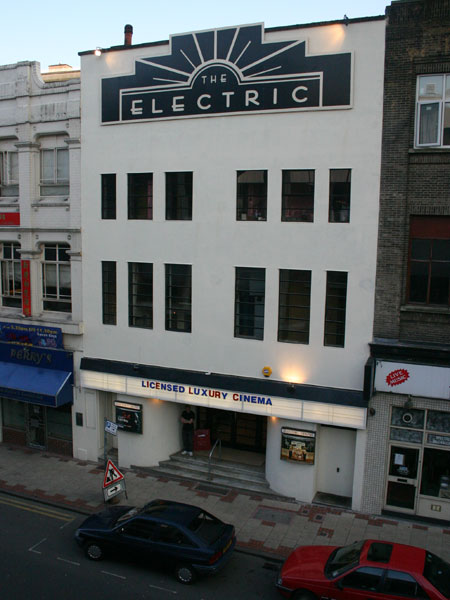
The then-Virgin chain opened a cinema that was less than ten minutes walk from my flat: twelve screens with perfect air conditioning, THX-certified sound, perfect raking & legroom. The programming included both blockbusters and indie movies from all over the world (Almodovar's newer releases, Susanne Bier, Lars von Trier, Studio Ghibli, you name it). A (then available) four-weekly or eight-weekly pass cost next to nothing. My monthly cinema bill went down from £100-£150 to less than a tenth of that. My visits to the Electric dropped to zero.

A few years later, The Electric closed and the building was left derelict. I felt a slight pang of remorse on my way to air-conditioned luxury and a perfect view as I knew that it was people like me who were responsible, but how could The Electric compete with great facilities and note-perfect programming? Sure, I had to go out and moan occasionally about an out-of-focus picture, missing sound or noisy patrons as opposed to The Electric's silence and rock-solid projection, but this was a small price to pay; a very small price (see above: less than a tenth).
My Cineworld went all digital; the first conversions were pretty obviously funded by European grant money, judging from the first movies shown on those two screens (10 & 12 for detail obsessives). But once whatever contractually-obligated minimum period had expired and as it started to make commercial sense to convert all the other screens, the cinema discovered the commercial benefits of Bollywood movies, a category I have absolutely no interest in. All of a sudden the cinema effectively lost two or three screens to me and the indie movies I loved were nowhere to be found.
The Electric meanwhile reopened as some kind of luxury cinema with leather sofas, stuffed olives and various flavours of gin. Both screens are now digital and look pretty good (the digital vs. film is a topic for another time). But I noticed that one week in 2009, one screen was playing the new 'Star Trek' movie while the other was playing 'Angels & Demons', both of which I'd assumed might be generally pretty accessible elsewhere. On one particularly memorable occasion, I went to see a one-off screening of 'The Spy Who Loved Me' (the first movie I can remember seeing at the cinema) with Richard Kiel who plays Jaws in attendance. My boyfriend was pretty ill and I was fairly drunk, but the main reason I walked out was because after presumably failing to get hold of a print, the cinema was projecting the DVD. The DVD. Not a blu-ray. The DVD. No-one else with their olives, their gin or their sofas seemed to mind. Needless to say I've never been back. And I'm never going to go back. I can't really think of a reason to pay to watch a movie on someone else's home cinema set-up when I have a perfectly good one at, well, home.
Do I blame myself for the fact that a lot of my movie-watching nevertheless now has to be done at home, courtesy of LoveFilm? Of course I do; I'm not an idiot. There are many lessons to be learned from this story, lessons about the power of monopoly, the true price of short-term financial gain, that it's better to have loved and lost than never to have loved at all, that you get what you pay for. But the main lesson? Never just walk out of a movie and run outside to get a cab, always stop and moan at the staff for projecting a ruddy DVD first; you'll never want to speak to them again after you've left.
Sunday, December 11, 2011
So-Called Director's Cuts & Revisionism
The archetypal Director's Cut was released in 1992.

The joke of course was that this was no such thing, as the vast bulk of the large list of edits that Ridley Scott had specified while he went to finish '1492: Conquest of Paradise' were ignored, as detailed in Paul Sammon's excellent book 'Future Noir'. Nevertheless, the trend started with that release became increasingly prevalent, with Special Edition cuts of 'Aliens' & 'Terminator 2: Judgment Day' getting prominent home video (remember that phrase?) releases and cinematic re-releases of 'Spartacus', 'The Abyss', 'E.T.: The Extra-Terrestrial', 'Alien', 'The Exorcist' and 'Apocalypse Now' among many, many others all featuring new versions. Editing between cinema and home video releases (there's that phrase again: home video releases. Is there something wrong with DVDs or blu-rays?) was nothing new even prior to this trend. Minor reframing, correction of continuity errors, slight edits were all fairly de rigeur; 'Batman' (1989) was made to look considerably brighter on home video compared to its original cinema release, at least partly due to the difference in projection mechanism.
Nowadays alternate cuts on even the initial blu-ray/ DVD release are commonplace, giving directors & studios the freedom to cut initial cinema releases for maximum commercial impact while retaining the ability to take a second bite at the cherry for reasons of artistic satisfaction or even just allowing audiences a peek behind the scenes of the creative process.
So where did this freedom get us? Greedo shooting first, of course. The best known example of creative revisionism (and one that I personally loathe) acts as the poster boy for why movies should be left alone. But the problem with this latter idea is that it implies that every movie has a definitive version. A few years ago, a small crew tried to finished 'Star Trek: The Motion Picture' as originally envisaged and without over-reliance on newer techniques and technology. In what way is the painstakingly finished result (the "Director's Edition") worth any less than the originally released movie? The 'Redux' of 'Apocalypse Now' feels like a totally different movie to the original, but not one that I could suggest was comparably beter or worse. James Cameron (director of 'The Abyss' and 'Aliens') studiously rejects the notion that any of the secondary releases constitute Director's Cuts in any way; he sees them as interesting alternates.
I'm hoping that the blu-ray of 'Star Wars' or 'Episode IV' or whatever we're supposed to call it today doesn't reveal that the Stormtrooper who hits his head on the door frame magically misses it. But equally well 'The Final Cut' of 'Blade Runner' really is my favourite take. The recent iteration of 'I Am Legend' would have been far stronger with its original ending. I like the inhabited base scenes in the newer take of 'Aliens' but the sentry guns add nothing that I find interesting. And just so we're really, really clear, Han shot in cold blood. The plethora of alternative versions of any movie out there has made the concept of a definitive version pretty much meaningless; figure out which one you like and stick with that!

The joke of course was that this was no such thing, as the vast bulk of the large list of edits that Ridley Scott had specified while he went to finish '1492: Conquest of Paradise' were ignored, as detailed in Paul Sammon's excellent book 'Future Noir'. Nevertheless, the trend started with that release became increasingly prevalent, with Special Edition cuts of 'Aliens' & 'Terminator 2: Judgment Day' getting prominent home video (remember that phrase?) releases and cinematic re-releases of 'Spartacus', 'The Abyss', 'E.T.: The Extra-Terrestrial', 'Alien', 'The Exorcist' and 'Apocalypse Now' among many, many others all featuring new versions. Editing between cinema and home video releases (there's that phrase again: home video releases. Is there something wrong with DVDs or blu-rays?) was nothing new even prior to this trend. Minor reframing, correction of continuity errors, slight edits were all fairly de rigeur; 'Batman' (1989) was made to look considerably brighter on home video compared to its original cinema release, at least partly due to the difference in projection mechanism.
Nowadays alternate cuts on even the initial blu-ray/ DVD release are commonplace, giving directors & studios the freedom to cut initial cinema releases for maximum commercial impact while retaining the ability to take a second bite at the cherry for reasons of artistic satisfaction or even just allowing audiences a peek behind the scenes of the creative process.
So where did this freedom get us? Greedo shooting first, of course. The best known example of creative revisionism (and one that I personally loathe) acts as the poster boy for why movies should be left alone. But the problem with this latter idea is that it implies that every movie has a definitive version. A few years ago, a small crew tried to finished 'Star Trek: The Motion Picture' as originally envisaged and without over-reliance on newer techniques and technology. In what way is the painstakingly finished result (the "Director's Edition") worth any less than the originally released movie? The 'Redux' of 'Apocalypse Now' feels like a totally different movie to the original, but not one that I could suggest was comparably beter or worse. James Cameron (director of 'The Abyss' and 'Aliens') studiously rejects the notion that any of the secondary releases constitute Director's Cuts in any way; he sees them as interesting alternates.
I'm hoping that the blu-ray of 'Star Wars' or 'Episode IV' or whatever we're supposed to call it today doesn't reveal that the Stormtrooper who hits his head on the door frame magically misses it. But equally well 'The Final Cut' of 'Blade Runner' really is my favourite take. The recent iteration of 'I Am Legend' would have been far stronger with its original ending. I like the inhabited base scenes in the newer take of 'Aliens' but the sentry guns add nothing that I find interesting. And just so we're really, really clear, Han shot in cold blood. The plethora of alternative versions of any movie out there has made the concept of a definitive version pretty much meaningless; figure out which one you like and stick with that!
Monday, November 28, 2011
Why Do People Make Bad Movies? And Who Are Critics to Judge?
A common criticism aimed at film critics themselves is that their opinion is worth no more than anyone else's. This is absolutely true. I need hardly add 'in my opinion', but I will anyway. Another frequent criticism is that critics know absolutely nothing about actually making movies and certainly very little about how difficult it can be. And with the exception of Truffaut, Godard and others in the French New Wave who are helpfully facetious exceptions, this is usually true as well. I for one know pretty much diddly about actual movie making. Sure I can spot great technique, cheerfully dissect the precise reasons I love or loathe something, look at the rhythm of the editing, analyse the cinematography and production design and figure out how the performances are working (or not). But I'm not a professional critic and neither do I pretend to actually know anything about film making or its trials. In a recent Vanity Fair profile, writer/ demi-God Aaron Sorkin suggested that director/ A N Other demi-God David Fincher doesn't like most movies, very possibly a little more eloquently than that. But he goes on to say that David Fincher doesn't talk badly of films he doesn't like as he respects just how difficult making movies is. So who are critics to judge movies and why on earth would anyone make bad ones?
The answer to the first of those questions is pretty easy. No matter how clear a director and crew are in their intentions for a movie, it doesn't amount to anything (not even the proverbial hill of beans) until someone views it - the 'art' actually happens in the screening process. An unscreened movie is just the cat in the box, waiting for us to figure out whether or not it's alive. And since everyone's experience is subjective, that make everyone a critic. Even you. And me. And yes, that does actually make me you. Scary, huh? As long as no-one pretends that their opinion is actually worth any more than any other then I think we'll be OK.
As for bad movies? Interesting. Francis Ford Coppola said in an interview promoting The Godfather Part III ("not the best one" - even advert copywriters are critics apparently, see?) that there was no such thing as 'good' and 'bad' art, that the only possible categorisation of art was as either 'sincere' or 'insincere' and that all sincere art should be considered of value. Although this was pretty ironic considering it's been suggested that he instigated that movie at least partially to ward off the fallout from a second bankruptcy, I think the comment has a lot of truth to it. For the record, I still love that chapter of The Godfather, albeit no, nowhere near as much as the first two, but then again I vastly prefer interesting or ambitious failures over mediocre successes any day of the week. I don't think anyone actually sets out to make bad movies, but sadly there's a lot (and by that I mean a LOT) of film making where the only apparent motive appears to be selling tickets. It's this kind of movie that I think we can safely describe as insincere art; many of these movies seem to be made under the ethos that audience enjoyment or artistic merit aren't remotely important. And before you accuse me of snobbery or elitism, I love at least as many blockbusters as you do and would happily defend their artistry to the hilt.
Personally, I've never been much of a believer in 'best' movie lists of any description or star ratings, even when I've found myself using the latter when both reading and writing about movies. I absolutely adore 'Citizen Kane', but it doesn't make me laugh anywhere near as much as 'When Harry Met Sally' or excite me as much as half a dozen Bond movies I could mention. And does it really matter whether the lobotomising 'Transformers 2' - see above - is described with half a star or no stars at all? I think it's safe to say that a lot of lists and comparisons, whether positive or negative, aren't always helpful when talking about movies.
Hence I'd suggest that one of the only valid criteria against which a movie can be evaluated is probably how successfully each member of the audience feels it measures up to the filmmakers' original intentions. And the only person that can determine that is, well, you. I'll let you be the judge of that.
The answer to the first of those questions is pretty easy. No matter how clear a director and crew are in their intentions for a movie, it doesn't amount to anything (not even the proverbial hill of beans) until someone views it - the 'art' actually happens in the screening process. An unscreened movie is just the cat in the box, waiting for us to figure out whether or not it's alive. And since everyone's experience is subjective, that make everyone a critic. Even you. And me. And yes, that does actually make me you. Scary, huh? As long as no-one pretends that their opinion is actually worth any more than any other then I think we'll be OK.
As for bad movies? Interesting. Francis Ford Coppola said in an interview promoting The Godfather Part III ("not the best one" - even advert copywriters are critics apparently, see?) that there was no such thing as 'good' and 'bad' art, that the only possible categorisation of art was as either 'sincere' or 'insincere' and that all sincere art should be considered of value. Although this was pretty ironic considering it's been suggested that he instigated that movie at least partially to ward off the fallout from a second bankruptcy, I think the comment has a lot of truth to it. For the record, I still love that chapter of The Godfather, albeit no, nowhere near as much as the first two, but then again I vastly prefer interesting or ambitious failures over mediocre successes any day of the week. I don't think anyone actually sets out to make bad movies, but sadly there's a lot (and by that I mean a LOT) of film making where the only apparent motive appears to be selling tickets. It's this kind of movie that I think we can safely describe as insincere art; many of these movies seem to be made under the ethos that audience enjoyment or artistic merit aren't remotely important. And before you accuse me of snobbery or elitism, I love at least as many blockbusters as you do and would happily defend their artistry to the hilt.
Personally, I've never been much of a believer in 'best' movie lists of any description or star ratings, even when I've found myself using the latter when both reading and writing about movies. I absolutely adore 'Citizen Kane', but it doesn't make me laugh anywhere near as much as 'When Harry Met Sally' or excite me as much as half a dozen Bond movies I could mention. And does it really matter whether the lobotomising 'Transformers 2' - see above - is described with half a star or no stars at all? I think it's safe to say that a lot of lists and comparisons, whether positive or negative, aren't always helpful when talking about movies.
Hence I'd suggest that one of the only valid criteria against which a movie can be evaluated is probably how successfully each member of the audience feels it measures up to the filmmakers' original intentions. And the only person that can determine that is, well, you. I'll let you be the judge of that.
Thursday, November 24, 2011
Skyfall

The consensus seems to be that Quantum of Solace was a relatively poor sequel to a modern classic and although I wouldn't really argue with that take on Casino Royale, I think the follow-up's a little unfairly maligned. Casino Royale's certainly my favourite Bond movie by a long shot, but it's by no means perfect: the whole stock market manipulation MacGuffin is still lost on me after 20+ viewings, the Prague-for-Miami location work, well, doesn't and neither does the Michael Mann-inspired cinematography in the airport action sequence. We can talk about the good bits some other time. Quantum of Solace meanwhile isn't given enough credit for the extraordinary amount of location work (probably the best presented locations of the series), ace production & costume design and some of the best cinematography the series has ever seen. [I have to admit that I didn't quite expect this post to resemble '"Friends, Romans, Countrymen" to quite the extent to which it's turning out, but that's classic for a reason, right?] The key issue with the sequel seemed to be its action sequences; both their sheer amount in the finished movie as well as their editing came in for criticism and it was suggested more than once that Bond must have felt Bourne nipping at his heels to have stolen his second unit director.
I personally love the sequel. Not as much as its immediate predecessor and admittedly at least partially out of the contractual obligations of fandom, but I love it nonetheless. And one of the main reasons I love it is because it does feel so dissimilar. It must be so tempting to trot out only slight variations on things that work over and over again - particularly in something so formulaic as a Bond movie - that as a member of the audience I appreciate creatively interesting failures that much more. And whereas Casino Royale was almost the quintessential Bond movie, Quantum of Solace really was just so different.
So key cast & crew have been announced for Skyfall and the list of names suggests that the usual post-mortem has thrown up some interesting lessons for the producers. The big news is of course Sam Mendes, without doubt the most prestigious director ever to have taken the reigns of a Bond movie and one with whom Daniel Craig already has experience, thanks to the excellent adaptation of Road to Perdition. But with him seems to have arrived an absolutely killer cast: Javier Bardem, Ralph Fiennes & Albert Finney are much bigger names than Bond films can usually attract and even smaller names (Naomie Harris, Ben Whishaw & Helen McCrory) are way more accomplished actors than is typical. Some serious money's also been spent on the script again. After the producers' annoyance at Paul Haggis over the latter's involvement in the writers' strike (contributing to uncredited, on-set rewrites as well as the reduction in the drama to action ratio) other big names were engaged: Peter Morgan apparently did a little work on top of the basic Purvis & Wade draft, but John Logan of The Aviator & Gladiator renown has since completed it. The other really big creative name is legend Roger Deakins as director of photography; probably best known for his longstanding work with the Coen Brothers, he's also filmed modern classics like Revolutionary Road & The Reader.
Quantum of Solace's production designer's been retained, but the other key names (special effects supervisor, stunt co-ordinator, second-unit director and editor) all seem to be returning from Casino Royale. Contrary to moronic UK tabloid suggestions of no action, these names actually suggest that Skyfall will feature a return to the more tightly integrated blend of action and drama of that movie, which is reinforced by the drop in budget from $250m (!) to $200m (action's expensive, drama's relatively cheap). And - assuming I've got the girls the right way around! - a French Bond girl is of course only the icing on the cake.
The marketing onslaught is of course going to be relentless for the 50th anniversary movie and - for this fan at least - ruddy expensive. The good news is that the talent involved so far strongly suggests that the film's going to be worth it.
Subscribe to:
Posts (Atom)